 Indian Thought Latest News & Views

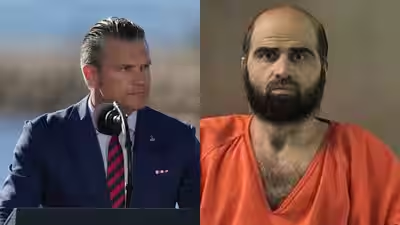
Washington: Nidal Malik Hasan, who carried out the 2009 shooting at the Fort Hood military base in the US, is set to be executed by a firing squad. ( squad) The Pentagon announced on Thursday that the entire process would be broadcast live. According to the US Army, Hasan’s execution is scheduled for December 3 at Fort Hood, Texas. This case has sparked a fresh debate in the US regarding methods of execution, government transparency, and the ethics of publicly displaying an execution.
13 people died in the 2009 shooting
Nidal Malik Hasan was a Major and a psychiatrist in the US Army. On November 5, 2009, he entered a medical building at the Fort Hood military base in Texas, where soldiers were queuing for vaccinations and mandatory pre-deployment medical checks. Hasan opened fire there. Thirteen people were killed and 32 others injured in the attack. He also fired at fleeing soldiers from behind. After being convicted in the case, he is now set to face the death penalty in accordance with a military court’s ruling.
Pete Hegseth had said, ‘The execution will be public’
US Secretary of Defense Pete Hegseth stated on Wednesday, while speaking to the TV channel *Real America’s Voice*, that steps would be taken to ensure people could witness the execution and that the process would be public. However, he had not explicitly mentioned a live broadcast at that time. On Thursday, Pentagon officials confirmed that the execution by firing squad would be broadcast live. Officials stated that further details regarding this plan would be provided later. This announcement has raised several questions regarding the military justice system.
Could Nidal Malik Hasan’s execution be delayed?
According to experts, Nidal Malik Hasan could file a petition in a civilian court challenging his sentence. Such a filing is known as a *habeas corpus* petition, used to challenge the legality of a person’s detention or the associated legal proceedings. This could lead to significant delays in the execution. Eugene R. Fidell, a visiting lecturer and military law expert at Yale Law School, stated that the legal process could extend beyond the term of the current US administration. He added that it is also uncertain whether the next administration would maintain the same stance on the death penalty.
Some experts also favor a live broadcast.
Deborah Denno, a law professor at Fordham University and an expert on the death penalty, said that a live broadcast of the execution could make the entire process more transparent. It would allow the public to see what the process of carrying out a death sentence actually entails. She noted that questions regarding this issue have arisen following complications during the lethal injection execution of Christa Pike in Tennessee. In such a context, a live broadcast could help the public understand execution methods and the associated challenges. However, the ethical and legal questions involved are also significant.
Why is the firing squad being considered an option?
Brener Fissell, a law professor at Villanova University and vice president of the National Institute of Military Justice, stated that many US states struggle to procure the drugs necessary for lethal injections and to find medical professionals willing to participate in the procedure. Consequently, some have begun to view the firing squad as a less inhumane alternative. According to Fissell, execution by shooting can be a more precise method. He believes that through this decision, Hegseth aims to demonstrate the military’s lethal capability and its tough stance. Trump has previously opposed public executions in Iran
US President Donald Trump has approved the death sentence for Hasan. However, he has previously criticized public executions in Iran. Citing concerns about the potential execution of protesters in Iran, Trump had frequently spoken of pressuring the government there. This issue had also been a topic of discussion prior to a potential US military strike on Iran on February 28. Speaking to reporters on January 14, Trump stated he had been informed that killings in Iran were ceasing and there were no plans for executions.
Hasan admitted to being the attacker in court
During his trial, Hasan dismissed his lawyers and represented himself. At the start of the hearing, he admitted to the jury that he was the one who had carried out the shooting. He spoke very little over the following three weeks. His court-appointed standby counsel believed his objective was to secure the death penalty. The military prosecution presented nearly 90 witnesses, but Hasan called no witnesses for his defense and did not deliver a closing argument.
‘Attacked to save Muslims’
Hasan also provided documents to journalists during the trial. These documents revealed he had told military mental health staff that even if sentenced to death, he could be considered a martyr. Hasan claimed he had launched the attack to prevent soldiers from deploying to Afghanistan and killing fellow Muslims there. However, in 2013, the military judge denied him permission to present this argument as a defense. Hasan was paralyzed from the waist down after being shot in the back by law enforcement officers; he now uses a wheelchair.