 Indian Thought Latest News & Views

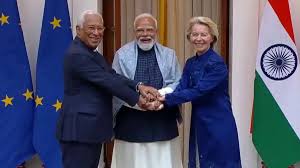
Delhi: India and the European Union on Tuesday announced the completion of negotiations for a free trade agreement (FTA) ( FTA ) . An official said that under this agreement, several domestic sectors such as apparel, chemicals, and footwear will get duty-free access to this group of 27 countries. Meanwhile, the European Union (EU) will get access to the Indian market at concessional duties for cars and wine. This agreement, concluded after more than two decades of negotiations, has been called the ‘biggest ever’ agreement. It will create a market of approximately two billion people. Here we are going to tell you the main points of the FTA between India and the European Union.
Some key points related to the FTA
Except for automobiles and steel, almost all Indian goods (more than 93 percent) will get zero-tariff entry into the European Union. For the remaining items, Indian exporters will receive duty reductions and quota-based tariff concessions.
This agreement is a strategic success in the country’s global trade engagement, which will open up vast opportunities in the $20 trillion EU market for 1.4 billion people.
The European Union will eliminate import duties on 90 percent of Indian goods on the very first day of the implementation of this free trade agreement.
The agreement is expected to be signed later this year and is likely to come into effect in early 2027.
The European Union will get duty-free access for 93 percent of its goods in India over a period of ten years.
India will remove duties on only 30 percent of European goods on the first day of implementing the agreement. India is also giving the EU tariff concessions and quota-based reductions on 3.7 percent of the trade value. Overall, India is offering tariff concessions to the EU on 97.5 percent of trade value.
Key Indian products with zero tariffs include textiles, apparel, marine products, chemicals, plastics, rubber, leather, footwear, base metals, gems and jewelry, furniture, toys, and sporting goods. Currently, these sectors face tariffs ranging from 0 to 26 percent in the European Union.
In the auto sector, both sides have negotiated quota-based tariff concessions, as the EU’s demands in this sector are very aggressive.
India’s auto sector is largely dominated by small cars (priced between ₹10 lakh and ₹25 lakh). The EU does not have much interest in this segment.
Currently, India’s import duty on automobiles ranges from 66 percent to 125 percent. India will not offer any tariff reductions outside the quota.
India’s quota for electric vehicles will begin from the 5th year of the agreement. Tariff reductions for EVs will vary across different segments. In the first year, it will be 35 percent in some segments and 30 percent in others. It will then gradually decrease.
Which items from Europe will become cheaper in India?
Items from Europe that will become cheaper in India include luxury cars, wine, spirits, beer, olive oil, kiwis, pears, fruit juices, processed foods such as bread, pastries, biscuits, pasta, chocolates, pet food, lamb, sausages, and other meats. These items currently attract tariffs ranging from 33 percent to 150 percent. After the FTA comes into effect, premium luxury European cars like BMW, Mercedes, Lamborghini, Porsche, and Audi are likely to become cheaper in the Indian market, as India will provide quota-based import duty concessions under this agreement. The EU will phase out tariffs on Indian automobiles, while India will reduce tariffs on EU cars from 110 percent to 10 percent, subject to an annual quota of 250,000 units.
EU goods such as machinery and electrical equipment, aircraft and spacecraft, optical, medical and surgical instruments, plastics, chemicals, iron and steel, and pharmaceuticals will gain duty-free access to Indian markets, making these items cheaper. Tariffs on expensive wines imported from Europe will be reduced from 150 percent to 20-30 percent over seven years. Beer will be taxed at 50 percent, down from 110 percent, and spirits at 40 percent. However, there will be no concessions for wines priced below 2.5 euros. This will also make European wines, beers, and spirits cheaper in India.
European Union becomes India’s 22nd FTA partner
The European Union has become India’s 22nd FTA partner. Since 2014, the NDA government has signed trade agreements with Mauritius, the UAE, the UK, EFTA, Oman, and Australia, and has announced a trade agreement with New Zealand. India signed trade agreements with Oman and the UK in 2025 and announced the conclusion of a trade agreement with New Zealand.