 Indian Thought Latest News & Views

Kolkata: Under the second phase of the West Bengal Assembly ( Assembly ) elections, voting for 142 seats is scheduled to take place on Wednesday. The Election Commission has put in place unprecedented security arrangements for this purpose. More than 3.5 lakh personnel from Central Forces have been deployed for this voting process, which is being held across seven districts of the state. These personnel include troops from the CRPF, SSB, RPF, ITBP, and CISF. In Kolkata alone, approximately 35,000 personnel have been deployed, while 2,550 companies are managing security across the entire state. The Election Commission has also deployed 142 General Observers and 95 Police Observers.
NIA Deployed in Elections for the First Time
For the first time in any election, the National Investigation Agency (NIA) has also been pressed into service. The entire operation is being monitored from a Central Control Room in Kolkata, which has been divided into seven clusters, with a nodal officer assigned responsibility for each cluster. Every polling station is being kept under surveillance via CCTV cameras, with live feeds being transmitted directly to the Control Room. The Control Room for the CAPF (Central Armed Police Forces) is linked with election officials at both the state and district levels. To ensure security, more than 6,000 ‘Quick Response Teams’ have been formed, while armored vehicles continue to patrol sensitive areas.
‘SIR’ Emerges as a Major Issue in This Phase of Elections
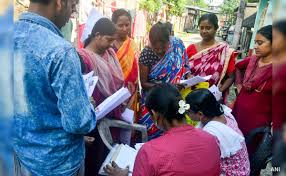
The Election Commission has also issued helpline numbers to ensure that any irregularities can be reported immediately. Voting for the first phase, covering 152 seats, was completed on April 23, and now all eyes are on the second phase. In this second phase, a total of 32,173,837 voters are set to exercise their franchise. The issue of ‘SIR’ (Summary Revision of Electoral Rolls) remains a major point of contention in this phase, as a large number of names have been struck off the voter lists in several districts. In North 24 Parganas, 1.25 million votes have been removed; in South 24 Parganas, approximately 1.1 million; in Howrah, 600,000; in Hooghly, 450,000; and in Nadia, about 485,000 votes have been struck off. There are approximately 25 seats where these removed votes could determine the margin of victory or defeat.
**All Eyes Nationwide Are on the Bhabanipur Seat**
Kolkata’s Bhabanipur seat is currently the subject of the most intense discussion, featuring a contest between TMC chief and Chief Minister Mamata Banerjee and the BJP’s heavyweight leader, Suvendu Adhikari. Here, the names of approximately 51,000 voters—accounting for 25 percent of the electorate—have been removed from the voter list. The Trinamool Congress alleges that this is a conspiracy, while the BJP dismisses the claim. The Bhabanipur seat is often referred to as ‘Mini India,’ as it is home to people from diverse communities. In the previous by-election, Mamata Banerjee won this seat by a margin of 58,000 votes; however, in the 2024 Lok Sabha elections, that margin narrowed to just 8,000 votes, leading observers to anticipate a fierce contest this time around.
**The Atmosphere is Heated in South 24 Parganas**
Among the seven districts involved, North and South 24 Parganas are considered the most critical, as 64 of the total 294 assembly seats are located within these two districts alone. In the previous election, the Trinamool Congress secured 58 of these seats. Key constituencies include Barrackpore, Barasat, and Bongaon in North 24 Parganas, as well as Diamond Harbour and Alipur in South 24 Parganas. South 24 Parganas has a Muslim population of approximately 35 percent, and the electoral atmosphere here is currently highly charged. Consequently, it is anticipated that the second phase of the elections will witness fierce contests between the BJP and the TMC across the majority of these seats.
**The BJP Has Stepped Up Its Efforts This Time**
The Nadia district also holds significant importance in the second phase, given that in the previous election, the BJP won 9 out of the 17 seats in the district. Here, the votes of the Matua and Namashudra communities are considered to be the decisive factor. This time, issues such as the NRC and CAA could also influence the elections. Prime Minister Narendra Modi has pledged to grant citizenship to refugees, whereas the Trinamool Congress is opposing the NRC. In the previous election, the Trinamool Congress won 123 out of the 142 seats across these seven districts, while the BJP secured only 18 seats. This time around, the BJP has intensified its efforts, with Narendra Modi, Amit Shah, and Yogi Adityanath campaigning vigorously.
**The Key Lies with Hindu and Women Voters**
Experts believe that even a slight shift in the voting preferences of Hindu and women voters could impact the results in 73 of the 142 seats. In the urban areas of these districts, issues such as employment, education, and healthcare also hold significant importance. All in all, amidst tight security and political tension, the entire nation is watching the voting scheduled for tomorrow, as its outcome could determine the future trajectory of Bengal’s politics.