 Indian Thought Latest News & Views

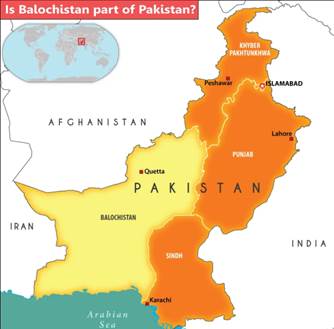
A viral tweet ( tweet) issued by Baloch leader Mir Yar Baloch in the name of the “Republic of Balochistan” has caused a stir; it claims control over 85 percent of the province’s territory and declares Balochistan an independent nation. For this new country, the Baloch people have announced a separate administrative system, a new national flag, a national anthem, and a new currency named the “Balochi Phaloos.” The viral document claims that Baloch separatists have declared independence from Pakistan. Although there has been no independent confirmation of these claims, this development has once again placed Balochistan at the center of global debate.
Why is Balochistan so significant?
When Pakistan separated from India, Balochistan—Pakistan’s largest province by area—became part of it. If Balochistan were to secede from Pakistan, the country’s very existence could be jeopardized. Despite its vast size, Balochistan has the smallest population and remains one of the least developed regions. Bordering Iran and Afghanistan, the province holds immense strategic importance. Balochistan is rich in natural resources such as copper, gold, natural gas, coal, and rare minerals. Most importantly, its geographical location—situated along the Arabian Sea—makes it a crucial gateway connecting South Asia, the Middle East, and Central Asia.
What sparked the rebellion in Balochistan?
The roots of the rebellion in Balochistan date back to 1947, when India and Pakistan were partitioned. At that time, Baloch leaders opposed the region’s inclusion in Pakistan. Balochistan has witnessed multiple uprisings—occurring in the late 1940s, the 1950s, 1960s, and 1970s, and again since the early 2000s. The rebellion that began back then continues to this day. The causes of the insurgency in Balochistan include issues regarding autonomy, control over resources, political representation, and alleged human rights violations by Pakistan.
**What is the history of Balochistan?**
At the time of the partition of India and Pakistan, the region now known as Balochistan comprised four major princely states: Kalat, Makran, Las Bela, and Kharan. Among these, Kalat was the largest and most influential. On August 11, 1947, the Khan of Kalat, Mir Ahmad Yar Khan, declared it an independent nation. British officials recognized Kalat, and the state initially remained outside both India and Pakistan. In contrast, its neighboring states—Makran, Las Bela, and Kharan—decided to join Pakistan, leaving Kalat isolated.
Kalat sought India’s support and held discussions regarding a potential merger with India; however, no such agreement was reached. After remaining independent and sovereign for 227 days, Kalat became part of Pakistan on March 20, 1948, and was designated as Balochistan. The State of Kalat had agreed to the merger on the condition that the Pakistani government would not interfere in its internal affairs. However, the reality turned out to be the opposite; Pakistan has consistently attempted to assert total control over Balochistan through the use of force.
**Why did the rebellion erupt in Balochistan?**
Balochistan has been the epicenter of Pakistan’s longest-running internal conflict. Despite supplying natural gas to the rest of Pakistan for decades, approximately 70% of Balochistan’s population lives in poverty. For decades, Baloch nationalist groups have accused Pakistan’s central government of exploiting the province’s resources while neglecting local communities. This has fueled a long-standing separatist insurgency. Militant and separatist organizations, such as the Baloch Liberation Army, frequently carry out coordinated attacks on Pakistani security forces and infrastructure.
**Why is Balochistan so [important] for China?** Why is it significant?
China’s interest in Balochistan is directly linked to the China-Pakistan Economic Corridor (CPEC), one of its ambitious flagship projects. Valued at over $65 billion, the CPEC aims to connect western China to the Arabian Sea through a network of highways, railways, energy projects, and ports. A crucial asset for China is the Gwadar Port, a deep-water port located on the Makran coast of Balochistan along the Arabian Sea. This location is a key hub for global maritime trade; it provides direct access to global shipping lanes and reduces reliance on the Strait of Malacca—one of the world’s busiest and most sensitive maritime chokepoints.
Can Balochistan become an independent nation?
Pakistan’s Defense Minister, Khawaja Asif, admitted in Parliament that Baloch insurgents are now using state-of-the-art weaponry—arms that even the Pakistani military does not possess. Pakistan itself has acknowledged the difficulty of dealing with the insurgency in Balochistan. Given the current state of the insurgency and Pakistan’s military strength, the likelihood of Balochistan immediately becoming an independent nation appears low; however, it is not impossible. Baloch groups periodically declare the formation of an independent nation, yet they have not received recognition so far.