 Indian Thought Latest News & Views

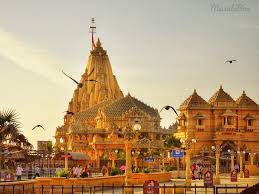
National News: The historic Somnath Temple on the shores of the Arabian Sea is not just a place of worship, but a living symbol of India’s resilience, faith and cultural revival. After facing repeated destruction over centuries, the temple today stands proudly with its magnificent golden spire, representing the victory of faith over invasion and destruction.
May 11, 2026 marks a historic moment for the country. It has been 75 years since the consecration of the modern Somnath Temple, while this year also marks 1000 years since the infamous attack by Mahmud of Ghazni in 1026.
A Sacred Legacy Rooted in Mythology
According to ancient Hindu beliefs, Somnath is the first among the twelve Jyotirlingas of Lord Shiva. Legends described in the Shiva Purana say that the Moon God worshipped Lord Shiva at this very site to regain his lost radiance after being cursed.
It is believed that the first temple was built in gold by the Moon God, later rebuilt in silver by Ravana, in wood by Lord Krishna and eventually in stone by King Bhimdev.
The Attack That Changed History
In 1026, Mahmud of Ghazni invaded Somnath with the aim of looting its immense wealth and crushing India’s spiritual identity. Historical accounts suggest that thousands of devotees, priests and local residents fought bravely to defend the temple.
Several records mention that nearly 70,000 people sacrificed their lives while protecting the shrine. The invaders destroyed the Jyotirlinga and carried away enormous treasures from the temple.
Destroyed Repeatedly, Rebuilt Every Time
Despite repeated invasions and destruction over centuries, Somnath continued to rise again and again. Different rulers and devotees rebuilt the temple in various periods of history.
Ahilyabai Holkar also played an important role in restoring worship at the sacred site by constructing a Shiva temple nearby.
Sardar Patel’s Vision Revived Somnath
After India’s independence in 1947, Sardar Vallabhbhai Patel visited the ruins of Somnath and pledged to rebuild the temple as a symbol of national pride and cultural resurgence.
The reconstructed temple was inaugurated on May 11, 1951 by India’s first President Rajendra Prasad, who declared that the power of creation is always greater than the power of destruction.
A Marvel of Architecture and Ancient Knowledge
The present-day Somnath Temple is considered one of the finest examples of traditional Indian temple architecture. Its towering structure and majestic sea-facing location attract millions of devotees every year.
One of the most fascinating features is the famous “Arrow Pillar” inside the temple premises, believed to indicate that there is no landmass between Somnath and the South Pole in a straight line — a remarkable example of ancient geographical understanding.
Modern Somnath: Heritage Meets Development
Under the leadership of Narendra Modi, major efforts have been made to modernize infrastructure around Somnath while preserving its spiritual and historical identity.
Improved highways, railway connectivity, airport expansion, digital facilities, cleanliness drives and environmental initiatives have transformed Somnath into one of India’s leading spiritual destinations.
Connected to Lord Krishna’s Final Journey
The Prabhas region is also deeply associated with Lord Krishna’s final moments on Earth. Nearby sites such as Bhalka Tirth and Dehotsarg Tirth are considered sacred by devotees.
This unique connection makes Somnath a rare spiritual center linked to both Lord Shiva and Lord Krishna.
A Timeless Symbol of Faith and National Pride
The story of Somnath is not merely about a temple. It is the story of survival, sacrifice, devotion and the enduring spirit of a civilization that refused to surrender.
Today, the golden spire of Somnath rising above the Arabian Sea stands as a powerful reminder that while structures may fall, faith and cultural identity can never be destroyed.