 Indian Thought Latest News & Views

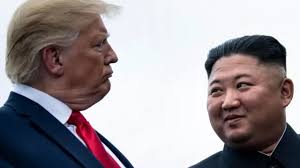
North Korea: Taking lessons from the attacks by the U.S. and Israel on Iran, North Korea has amended its constitution. ( Constitution ) According to this amendment, if leader Kim Jong-un is assassinated, or if a foreign adversary incapacitates him, the North Korean military will launch a retaliatory nuclear strike. In February, Iran’s Supreme Leader Khamenei and several of his close advisors were killed.
Amendment Made During the First Session of the Assembly
North Korea enacted this amendment during the first session of the 15th Supreme People’s Assembly, which commenced in Pyongyang on March 22. According to a report by *The Telegraph*, these changes were revealed during a briefing provided to senior government officials by South Korea’s National Intelligence Service (NIS).
Kim currently retains command of North Korea’s nuclear forces; however, the constitutional amendment formally defines the procedures for retaliatory action should he be assassinated or become unable to exercise leadership.
The amended Article 3 of the Nuclear Forces Policy Law states: “If the command-and-control system of the state’s nuclear forces is endangered by attacks from hostile forces, a nuclear strike shall be launched automatically and immediately.”
Iran Was a Wake-Up Call
Andrei Lankov, a Russian-born professor of history and international relations at Kookmin University in Seoul, stated that this change reflects growing concerns in Pyongyang following recent developments in Iran. He remarked, “This may have been the policy all along, but now that it has been enshrined in the constitution, it carries significantly greater emphasis.” He added, “Iran was a wake-up call.” “North Korea witnessed the extraordinary efficiency of the U.S.-Israeli ‘decapitation’ strikes—attacks aimed at eliminating top leadership—which instantly wiped out a significant portion of the Iranian leadership; consequently, they must now be thoroughly terrified.”
**An Operation Like the One in Iran Would Not Be Easy in North Korea**
Experts believe that conducting a similar operation in North Korea would be far more difficult than it was in Iran, as the country is completely isolated and its security controls are extremely stringent. North Korea’s borders remain largely sealed, and foreign diplomats, aid workers, and businesspeople entering the country are kept under strict surveillance, thereby limiting opportunities for intelligence gathering.
Reports indicate that Israeli intelligence agencies monitored Iranian leaders in Tehran by hacking into traffic cameras; however, employing such tactics in Pyongyang would be challenging, given the limited CCTV network and the tight control exercised over the country’s intranet system. Kim Jong Un is also known for maintaining a rigorous personal security detail. He is constantly accompanied by bodyguards, avoids air travel, and typically travels aboard a heavily armored train.
Professor Lankov stated that Pyongyang’s primary concern is likely to be satellite surveillance technology. “Their greatest fear,” he noted, “would be the intelligence gathered through satellite technology.” “All in all, their concerns are not unfounded, as eliminating the leadership right at the outset of any conflict could potentially prove decisive.”
**North Korean Military Loyal to Its Leadership**
He further stated that the North Korean military remains loyal to its leadership, and should an attack occur, they would likely follow orders to launch a retaliatory strike. Professor Lankov remarked, “I see no possibility of an attack originating from South Korea; therefore, any retaliatory action would be directed at the United States.”
**Preparations to Deploy Howitzers**
Meanwhile, North Korea has also begun preparations to deploy new 155mm self-propelled howitzers near the border with South Korea. According to state media, these weapons possess a range exceeding 37 miles, enabling them to strike targets as far away as Seoul. Tensions between North and South Korea persist unabated. Technically, both nations remain in a state of war, as the Korean War of 1950–53 concluded with an armistice agreement rather than a formal peace treaty.