 Indian Thought Latest News & Views

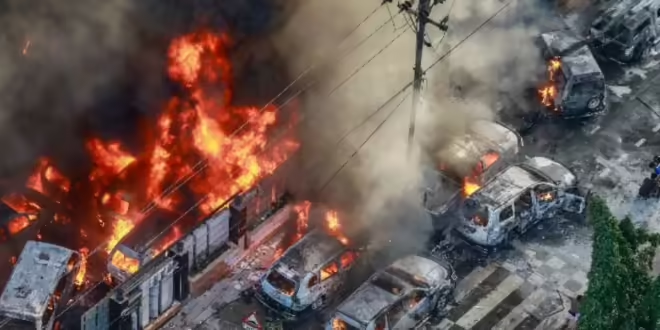
Dhaka/Chittagong/Khulna: The situation in Bangladesh is deteriorating day by day following the attack on and subsequent death of radical youth leader Sharif Usman Hadi. Tensions are rising in areas near the border, while members of the extremist group are rioting across the country. Violence is raging from the capital Dhaka to the port city of Chittagong and the industrial hub of Khulna. Extremists are declaring war against India and specifically targeting Hindus. In Mymensingh city, a Hindu (Hindu ) man was publicly burned alive in a town square. Rioters set fire to the offices of two newspapers in Dhaka and chased and beat journalists. The reporters’ lives were saved with the help of the army. The rioters’ rampage continues throughout Bangladesh, with the rioters talking about “180 million Hadis,” but the head of the government, Muhammad Yunus, is silently watching the spectacle.
Violence erupts after Usman Hadi’s death
Late Thursday night, Bangladesh’s Chief Advisor Muhammad Yunus announced that Sharif Usman Hadi, leader of the Inqilab Manch, had died in Singapore. As soon as the announcement was made, radicals took to the streets across Bangladesh. Throughout the night, vandalism, arson, and violence continued in different cities. This evening, when Hadi’s dead body arrived in Dhaka, thousands of Inqilab Manch supporters gathered at Dhaka’s Shahjalal Airport. This crowd had come to receive the dead body of Sharif Usman Hadi, one of the leaders who overthrew Sheikh Hasina last year. Seven days ago, on December 12, Sharif Usman Hadi was shot by unknown assailants. Muhammad Yunus had sent Hadi to Singapore by air ambulance for treatment, where he died yesterday.
Hadi was an opponent of Sheikh Hasina and India
Usman Hadi was a key leader of the rebellion against Sheikh Hasina’s government last year. He had promised to implement Islamic law in Bangladesh. Usman Hadi was a staunch opponent of India and the spokesperson of the Inqilab Manch. However, the Yunus government dissolved the Inqilab Manch. Following this, Usman Hadi announced in February that he would run as an independent candidate. On December 12, Usman Hadi launched his campaign, and on the same day, he was shot. As soon as Usman’s death was confirmed last night, extremists unleashed violence across Bangladesh. The crowd was chanting slogans like “Hang Hadi’s killers! Hang them!” In fact, as soon as Mohammad Yunus confirmed Usman Hadi’s death last night, the Inqilab platform appealed to people to come out of their homes, and millions of people took to the streets across the country.
Jamaat members caused widespread unrest in Dhaka
After Hadi’s death, Jamaat members unleashed widespread violence. Vandalism, looting, and arson broke out everywhere in the capital, Dhaka. The violent mob of extremists attacked offices, markets, and the homes of leaders of Sheikh Hasina’s Awami League party. Anyone who came in their way was brutally beaten. Rioters took control of numerous areas, including Old Dhaka, Ahsan Manzil, Shahbagh, Karwan Bazar, Dhanmondi, Bashundhara, Banani, and Baridhara. The extremists openly looted and committed arson, but the police were nowhere to be seen.
Hadi’s supporters also targeted the media
The same Usman Hadi, for whom the extremists set all of Dhaka ablaze, himself used to chant slogans calling for Sheikh Hasina to be crucified and Awami League government ministers to be shot in public squares. Surprisingly, at that time, a large section of the Bangladeshi media was supporting extremists like Usman Hadi and portraying them as heroes. But after Usman Hadi’s death, his supporters targeted the media itself. They attacked the offices of Bangladesh’s largest English newspaper, the Daily Star, and the Bengali newspaper Prothom Alo. First, the mob vandalized the offices of Prothom Alo and the Daily Star. When the employees of both newspapers fled their offices to save their lives, a mob of rioters looted all the equipment from the newspaper offices, including laptops, computers, and projectors. Then, the offices of the Daily Star and Prothom Alo were set on fire.
Many questions raised about the role of the police
The mob of rioters remained outside the newspaper offices until around 4:30 in the morning. Those who escaped the wrath of the extremists raised questions about the role of the police. They alleged that the police and fire brigade teams deliberately arrived late and did not intervene promptly.