 Indian Thought Latest News & Views

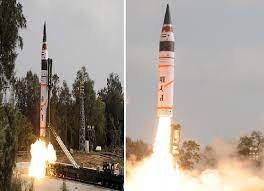
Delhi: India has successfully test-fired its new-generation Agni-Prime missile, (-Prime missile ) fired from a rail-based mobile launcher. The missile has a range of 2,000 kilometers and was jointly launched by the Defence Research and Development Organisation (DRDO) and the Strategic Forces Command (SFC). The test was conducted under fully operational conditions. Defense Minister Rajnath Singh described it as a historic achievement, saying that this success puts India among a select group of countries capable of launching such weapon systems from a rail network. Let’s explore why the Agni-Prime missile is considered so special.
1. Canisterization: Fast and Safe Launch
Canisterization means the missile is placed in a sealed container, allowing it to be both stored and launched. Its biggest advantage is that it significantly reduces the time required to prepare the missile. While many missiles take considerable time to prepare for launch, Agni Prime can be prepared in just a few minutes. Furthermore, canisterization protects the missile from environmental damage (such as rain, dust, or heat) and ensures its long-term safety. This feature gives India the ability to quickly respond, which is crucial in war-like situations.
2. Rail-Based Mobile Launcher: Launching from Anywhere
Another unique feature of Agni Prime is its rail-based mobile launcher. The missile can be fired from a specially designed rail launcher, which can travel anywhere on the country’s rail network without any special preparations. This means that the missile is extremely easy to transport and launch from one location to another. This feature makes it very difficult for enemies to detect the missile. Since it can be deployed anywhere on the rail network, it will be difficult for the enemy to guess where the missile is deployed. This gives India a strategic advantage, as such mobility makes the missile safe and effective.
3. Strategic Ambiguity: The Power to Confound the Enemy
Strategic ambiguity is Agni Prime’s greatest strength. The combination of canisterization and rail-based mobility ensures that the enemy never learns the missile’s exact location. This further strengthens India’s second-strike capability. This means that if an enemy attacks India, this feature of Agni Prime ensures that India can respond quickly and effectively. Its mobility and rapid launch capability make it a weapon that will be difficult for the enemy to counter.
What else is special about the Agni Prime missile?
According to the Ministry of Defense, Agni Prime features autonomous launch capability, as well as state-of-the-art communication systems and protection mechanisms. The missile’s flight path was tracked by various ground stations, and it was a textbook launch, meaning all mission objectives were fully achieved. This was the first time Agni Prime was fired from a rail-based launcher. This success paves the way for future induction of rail-based systems into the Army. Furthermore, a road-mobile variant of Agni Prime has already been inducted into the Army, meaning the missile can be launched via both road and rail.
What did Rajnath Singh say about the Agni Prime missile?
Defense Minister Rajnath Singh described this achievement as a major step forward in India’s defense capabilities. He said that this successful test puts India among the select few countries that possess the technology to launch canisterized missiles from rail networks. This not only enhances India’s military strength but also strengthens India’s strategic position regionally and globally. This test assumes even greater significance given the recent military tensions between India and Pakistan. Agni Prime’s ability to launch from anywhere, quickly, and stealthily ensures India’s readiness to respond to any threat. Thus, Agni Prime is not just a missile, but a new chapter in India’s defense strategy, further strengthening the nation’s security.