 Indian Thought Latest News & Views

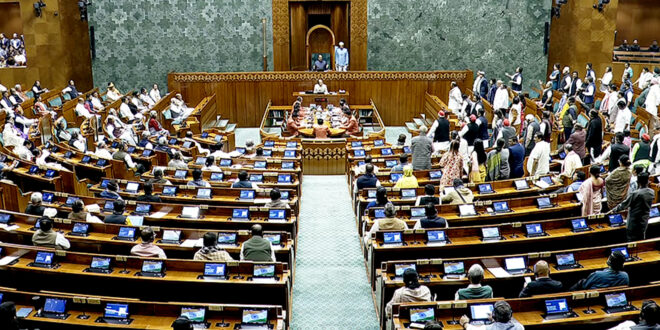
Delhi:In a major political (major political )and constitutional shift, the Government of India has introduced a set of Bills to expand the Lok Sabha to 850 seats and operationalise the long-pending women’s reservation through a fresh delimitation exercise.
The legislative package includes the Constitution (One Hundred and Thirty-First Amendment) Bill, 2026, the Delimitation Bill, 2026, and amendments to Union Territories laws. These proposals build on the earlier Constitution (One Hundred and Sixth Amendment) Act, 2023, which introduced one-third reservation for women but linked its implementation to delimitation after a Census.
At the heart of the reform is a proposal to increase the strength of the Lok Sabha from 543 to 850 members, significantly altering India’s parliamentary structure. The move also lifts the decades-old freeze based on the 1971 Census, allowing seat redistribution using updated population data—likely from the 2011 Census.
The amendment seeks changes to Article 81 of the Constitution of India, enabling the expansion of seats, while modifying Article 82 of the Constitution of India to focus on readjustment of constituencies rather than mandatory seat revision after every Census.
A key feature of the plan is the creation of a Delimitation Commission, which will be headed by a Supreme Court judge and include the Chief Election Commissioner. The panel will have powers equivalent to a civil court and will be responsible for redrawing constituency boundaries, allocating seats across states, and determining reservations for Scheduled Castes (SCs), Scheduled Tribes (STs), and women.
Once implemented, one-third of seats in Parliament and state Assemblies—including within SC/ST quotas—will be reserved for women. These reserved constituencies will rotate after each delimitation cycle, and the quota is set for 15 years, with scope for extension.
The proposed reforms also address delays in conducting the Census. By allowing Parliament to decide which Census data to use, the government aims to avoid waiting for the next population count and speed up the implementation of women’s reservation.
However, the move reopens a long-standing debate on federal balance. States in northern India, which have seen higher population growth, could gain more seats, while southern states that successfully controlled population growth may see their relative representation shrink. The government has assured that the proportional share of states will not be disturbed, though the exact formula will be determined by the commission.
The changes are expected to significantly impact electoral politics. A larger Lok Sabha will increase the majority mark, potentially reshaping coalition dynamics, while the rotation of women-reserved seats could disrupt established political strongholds.
While most opposition parties support women’s reservation, concerns remain over seat redistribution and the absence of a separate quota for women from Other Backward Classes (OBCs).
With these Bills, the government has set the stage for one of the most significant overhauls of India’s electoral framework in decades, combining representation reform with gender inclusion while navigating complex political and regional sensitivities.